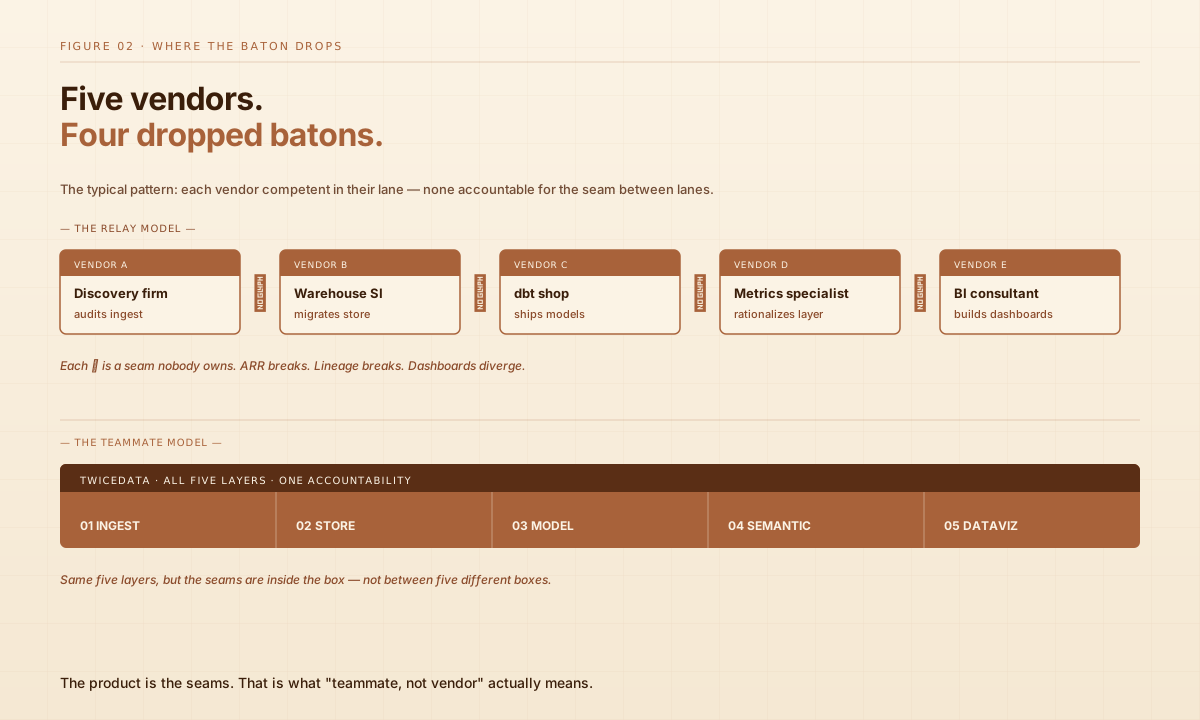
Most data consulting works like a relay race that drops the baton.
A discovery firm audits your ingest layer and ships a report. A modeling shop builds dbt code and disappears. A semantic-layer specialist comes in to “rationalize metrics” and never speaks to whoever built the dashboards. Each vendor is competent inside their lane. Nobody owns the seams where the lanes meet — which is where every real data problem actually lives.
We are deliberately not that. TwiceData engages as a teammate across the entire pipeline — ingest, store, model, semantic, dataviz — and stays accountable for the boundaries between layers as much as for the layers themselves. The framing matters. The framing is the product.
The five layers most data teams touch every week
Strip a modern SaaS data stack to its load-bearing parts and you find five surfaces that have to work together. Each one has its own vendors, its own failure modes, and its own way of subtly breaking the layer downstream when nobody is watching the seam.
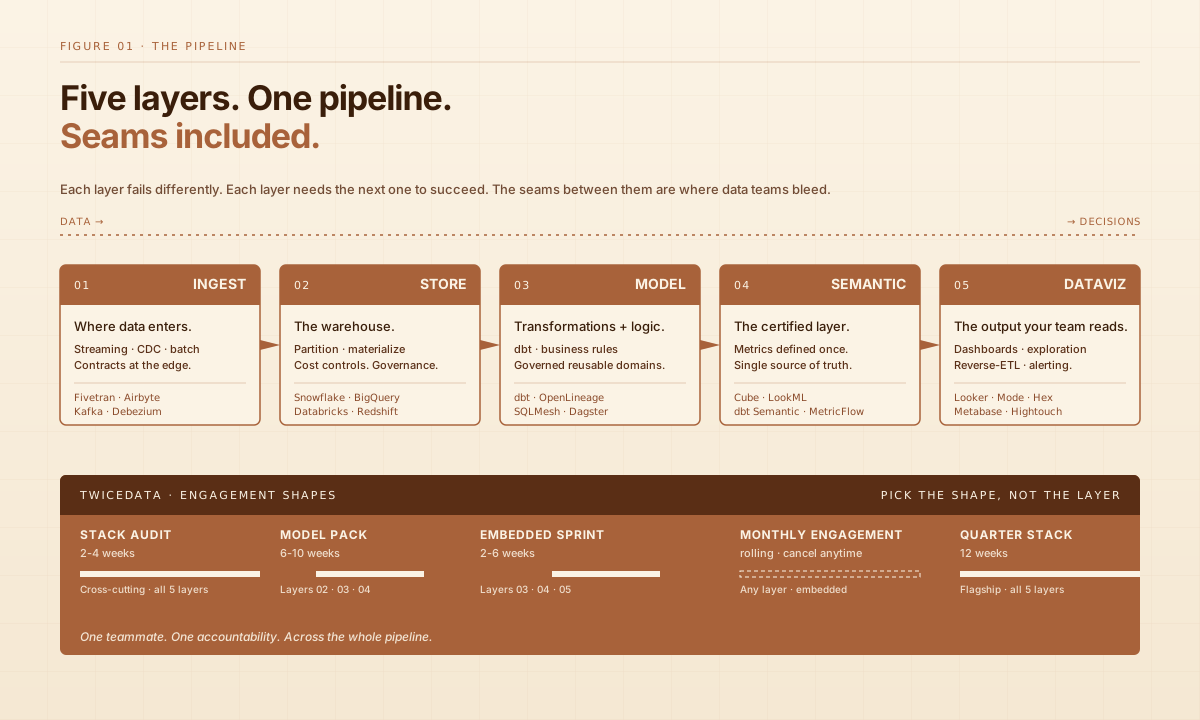
01 Ingest. Where data enters. Streaming pipes, change-data capture from your transactional store, batch loaders from third-party SaaS tools, event firehoses from product instrumentation. The single most underrated discipline at this layer is contracts at the edge — failing loudly when an upstream provider changes a schema rather than silently propagating bad data into the warehouse three hours later.
02 Store. The warehouse. Snowflake, BigQuery, Databricks, Redshift, increasingly DuckDB. Partition strategy, materialization plan, cost controls, governance. The bill where most data teams quietly bleed. We have seen a $42K/month Snowflake invoice drop to $19K with no architectural changes — just disciplined model consolidation and incremental builds at this layer.
03 Model. The transformations. dbt is the de-facto standard. The model layer is where business logic lives — ARR definitions, retention rules, the four versions of “active user” that finance, product, marketing, and the board each prefer. Governance discipline at this layer is the difference between a data team that ships and a data team that re-litigates the same metric every quarter.
04 Semantic. The certified layer. Metric definitions written once, exposed everywhere — Cube, LookML, dbt Semantic Layer, Mode’s metrics layer. This is the layer that finance, product, and the board can all sign. A governed semantic layer is the single most leveraged investment most mid-market data teams under-invest in.
05 Dataviz. The output. Looker, Mode, Hex, Metabase, Tableau, custom dashboards, reverse-ETL back to Salesforce or HubSpot for the operational tools that consume the data. The layer your team actually reads on a Monday morning.
Five layers, five vendor categories, five sets of failure modes. The discipline of running them as one pipeline owned by one teammate is what we mean by “teammate, not vendor.”
What “teammate” means in practice
The word gets thrown around. Here is the substance.
SOW-bound, not retainer-billed. Every engagement ships under a fixed-price statement of work with a defined day-of-handoff. You know exactly what you bought, what it costs, and when it lands. No time-and-materials surprises. No incentive on our side to drag out the work.
Across the seams, not just the layer. When we ship a dbt Model Pack, we wire it into the lineage layer, validate the semantic certification, and check the dashboards downstream still parse the new metric names. The Model engagement is the headline, but the seam-stitching is the work.
Ongoing optimization, not one-shot delivery. A subscription tier exists for after the engagement — monthly model reviews, BI adapter upgrades, semantic-layer refreshes. The optional half of “teammate” is staying around as your business shape changes.
Embedded availability. Slack channels, weekly check-ins, shared roadmaps. For the Monthly Engagement tier and the Quarter Stack tier, we treat your roadmap as a joint document, not a vendor backlog.
Senior-led, hands-on. No junior offshore handoff. The person in your Slack is the person writing the dbt. Period.
Four ways to engage, pick the shape not the layer
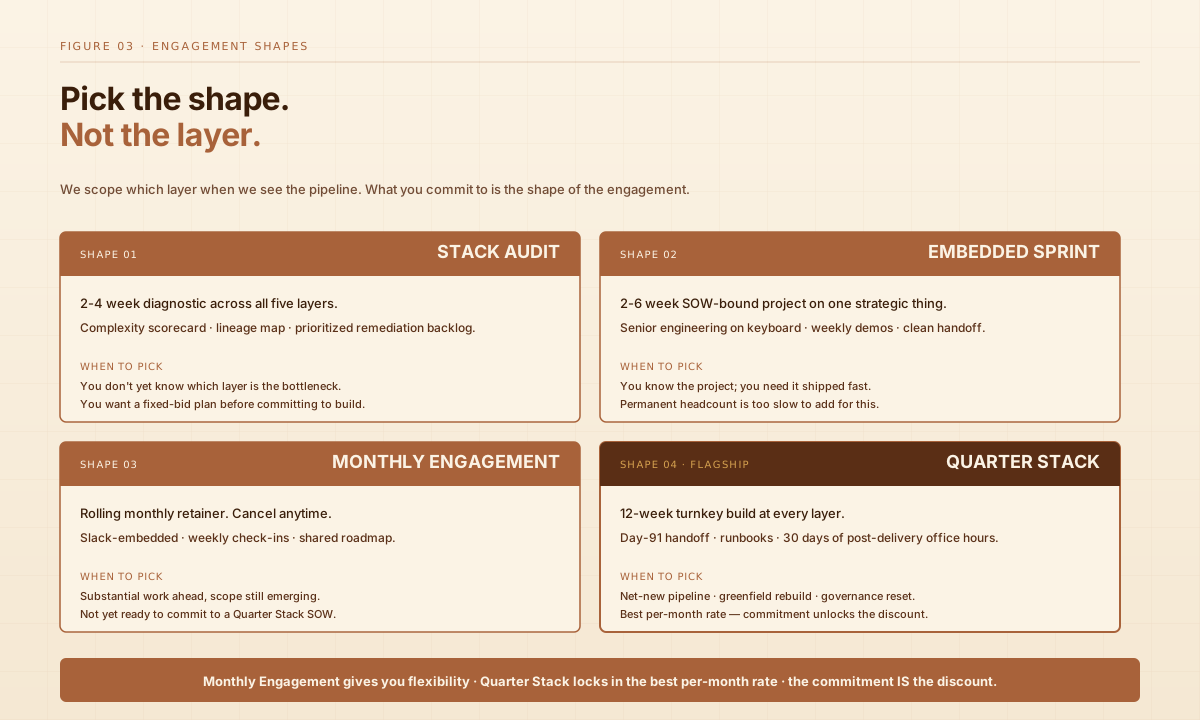
The shape of the work matters more than which layer it touches. A Model Pack engagement could land in your store, model, or semantic layer depending on where the metric mess actually is — we will scope which layer when we see your pipeline. What you commit to is the shape of the engagement.
- Stack Diagnostic — 2-4 week audit across all five layers. You get a remediation plan, a complexity scorecard, a lineage map, and a prioritized backlog. The right starting point if you do not yet know which layer is the bottleneck.
- Embedded Delivery Sprint — 2-6 weeks of senior data engineering on keyboard for one strategic project, SOW-bound. The fastest way to ship one important thing without adding permanent headcount.
- Quarter Stack — 12-week turnkey build of your full pipeline at every layer. Day-91 handoff with runbooks, post-handoff office hours. The flagship engagement when you want the whole thing delivered as one coherent system.
- Monthly Engagement — rolling monthly retainer with cancel-anytime flexibility. For when you need ongoing teammate availability but the scope is still emerging. Flip into Quarter Stack any time for a commitment discount.
Plus two specialized service lines that sit alongside the main pipeline:
- AI Consulting — first hour free. For teams figuring out where LLMs and agentic AI actually fit in their stack without burning a quarter of budget on a hallucination demo.
- Data Recovery & Forensics — productized recovery service for wiped disks, fragmented backups, e-discovery contexts. Built on a live OpenSearch index and the reconstruction pipeline we wrote for our own April 2026 recovery.
Where we will not pretend to operate
Honest about what we do not do, so you know when to call someone else.
- Hardware-level drive recovery — for physical-failure cases, DriveSavers or a forensic lab is the right first call. We pick up after the bytes are off the platter.
- Replatforming a data lake to Hadoop — modern cloud warehouses are our world. Legacy platform migrations beyond R/SAS modernization are not our default lane.
- Headcount augmentation — we are not a recruiting agency or staff-aug shop. If what you need is two more bodies on payroll, hire them. If what you need is the work shipped, talk to us.
What this looks like in practice
Concrete scenario, the kind we run almost every engagement: customer arrives with a freshly provisioned AWS account, the vendor’s transactional data sitting in a Postgres database, and a mandate from the board to produce governed metrics — fast. Twelve weeks later they have a working Databricks Lakehouse, dbt-modeled metrics, a governed semantic layer, Looker dashboards their team designs, AND an AI chat surface that answers natural-language questions on the same data — all owned by them in their own AWS account.
The pipeline at a glance: Postgres → AWS Lambda + Airflow → Databricks Lakehouse → dbt → Looker AND AI chat → your team. Five layers spanned in twelve weeks, with the AI chat layer as a parallel consumer of the same semantic layer that drives the dashboards.
Day 91 brings the handoff question: do we maintain it, or do you? Both are valid TwiceData outcomes:
- You maintain it. Runbooks, lineage docs, CI gates wired into your repo, 30 days of post-delivery office hours. Your engineers own the pipeline forever. We are a phone call away if you want, or we are out of the picture entirely. Your choice.
- We maintain it. Subscription tier kicks in. Monthly model reviews, BI adapter upgrades, semantic-layer refreshes, drift monitoring, AI-chat retraining. We keep the plumbing current; your team operates at the dashboard and chat surface.
Either way, you own it. The AWS account is yours. The data is yours. The code is yours. The Looker workspace is yours. The chat surface — model weights, vector index, FastAPI service — is yours. There is no proprietary TwiceData layer in the stack; everything is open-source or your-vendor-of-choice. You can hire any consulting shop tomorrow to take over from us and they will find a clean, documented system.
For the full end-to-end walkthrough — every week of the build, every architectural decision, the AI chat layer specifics, the runbooks we hand over, the cost economics — see the labs deep-dive: From a fresh AWS account to dashboards and AI chat — a TwiceData engagement walked end-to-end. It is the canonical reference engagement we deploy on this stack, with nothing left out.
How to start
The first hour of consultation is free. We use it to scope what is recoverable from your current stack, identify which layer the bottleneck actually lives in (often not the one the team thinks), and quote a fixed-bid scope if it is worth proceeding. If it is not, we will tell you that too.
Book a 30-minute architecture session — we send back a scoped proposal within 48 hours.
––